
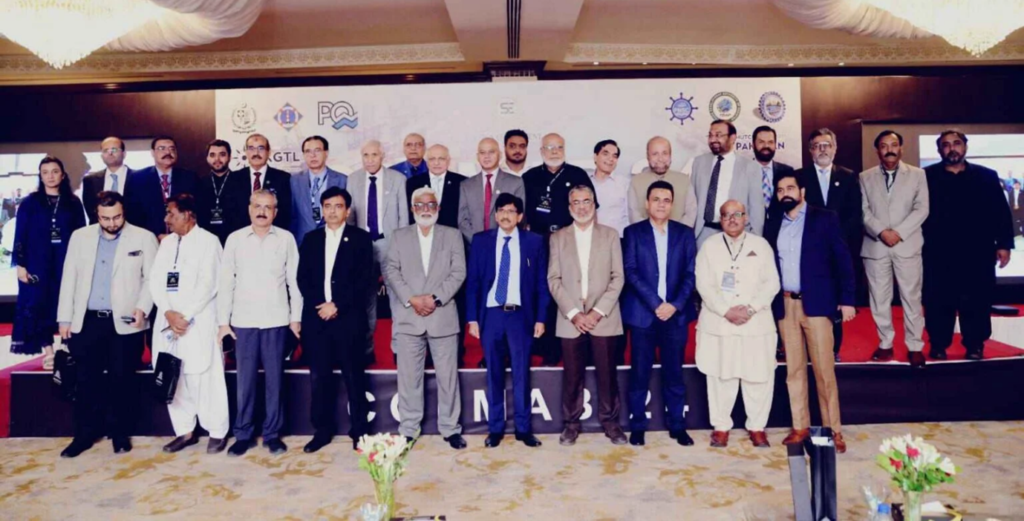
Syed Tanvir Ahmad, Senior Advisor, MACN was invited to make a presentation on the Blue Economy at a conference. The Senior Advisor informed the audience about the contributions made by GCNP-MACN towards the Blue Economy through Collective Action Project and efforts of GCNP and MACN in promoting transparency and ethical practices in Pakistan’s maritime industry, stakeholder engagement, and capacity building.
The Blue Economy is defined by the World Bank and the UN as the sustainable use of oceans and marine resources to promote economic growth, job creation, and environmental protection, aligning with the UN’s Sustainable Development Goal 14. Globally, it is valued at around $24 trillion annually, with oceans facilitating nearly 80% of world trade, though only $500–600 billion of this potential is currently realized. Pakistan, with its 1,050 km coastline, 290,000 sq. km Exclusive Economic Zone, and vast resources including hydrocarbons, minerals, fisheries, and mangroves, holds significant potential but currently generates just $450 million annually from the sector against a capacity of over $100 billion. Important areas include fisheries, maritime transport, shipbuilding, renewable energy, tourism, mineral exploration, and coastal economy, while seafood exports alone could rise from $450 million to $2–2.5 billion if supported by better infrastructure, quality control, and logistics.
Despite this vast promise, Pakistan faces challenges such as poor waste management, marine pollution, overfishing, climate change, weak infrastructure, bureaucratic hurdles, and regional instability, particularly in Balochistan. Projects like CPEC demonstrate recognition of the maritime sector’s strategic role, but progress requires more than rhetoric: the country must urgently revise and approve its National Maritime Policy, which has remained pending since 2014, and embed sustainability into its economic strategy. Institutional coordination, investment in infrastructure, and adoption of sustainable practices are crucial for unlocking the Blue Economy’s potential, generating millions of jobs, promoting regional integration, and driving long-term socio-economic growth.